
 Corrida Legal

India Entry & FDI Regulations: How To Setup Your Entity In India
India Entry & FDI Regulations: Learn business setup, FDI routes, prohibited sectors, and compliance rules in India.

With its vibrant economy and vast consumer market, India has become an increasingly attractive destination for foreign companies seeking to expand their global footprint. However, navigating the complexities of India’s Foreign Direct Investment (FDI) regulations can be daunting. Setting up a business entity in India requires a thorough understanding of the legal and regulatory framework to ensure compliance and maximise opportunities. This article delves into the intricacies of India’s FDI regulations and provides a comprehensive guide on how to establish an entity in this dynamic market.
Overview of India’s FDI Policy
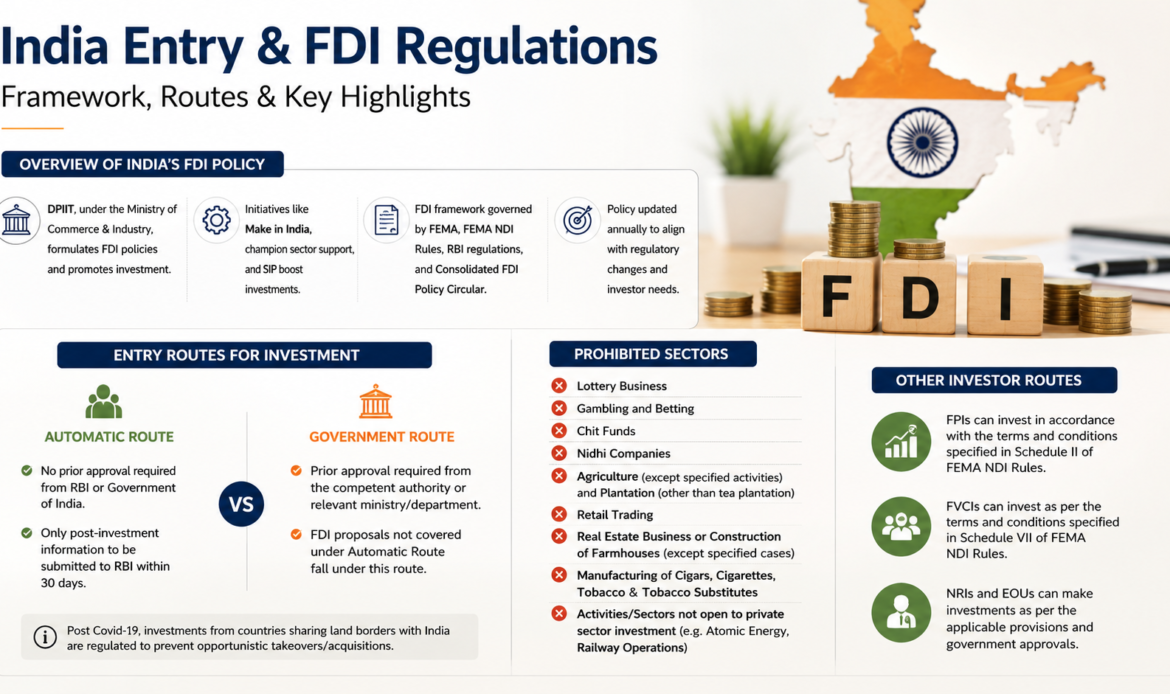
The Department for Promotion of Industry and Internal Trade (DPIIT) under the Ministry of Commerce & Industry is responsible for formulating FDI policies and managing data on inward FDI. Initiatives such as Make in India, champion sector support, and project development cells under the Scheme of Investment Promotion (SIP)[1] have been launched to promote investment.
The Consolidated FDI Policy Circular[2] (Policy) outlines the FDI framework. The Policy is formulated by the DPIIT. It is updated annually to align with regulatory changes. The Policy serves as a guiding framework for foreign investors, providing clarity and guidelines on various aspects of FDI in India. It ensures coherence with regulatory changes and aims to attract and facilitate investments that contribute to the nation’s economic growth and development.
The Policy has been unveiled in the form of amendments to the Foreign Exchange Management (Non-Debt Instruments) Rules, 2019 (FEMA NDI Rules), which fall under the Foreign Exchange Management Act, 1999 (FEMA). In case of any discrepancy between the operational provisions of the FEMA NDI Rules and the notification issued thereunder, the notifications shall take precedence. Furthermore, the inward remittance and reporting requirements are governed by the Foreign Exchange Management (Mode of Payment and Reporting of Non-Debt Instruments) Regulations, 2019, issued by the Reserve Bank of India (RBI). The regulatory framework for foreign investments in India encompasses FEMA, its associated rules and regulations, the Policy, press notes, releases, clarifications, and other relevant documents.
Read another article: Indemnity Clauses in India: Enforceability and Important Judgments
Choosing the right business structure
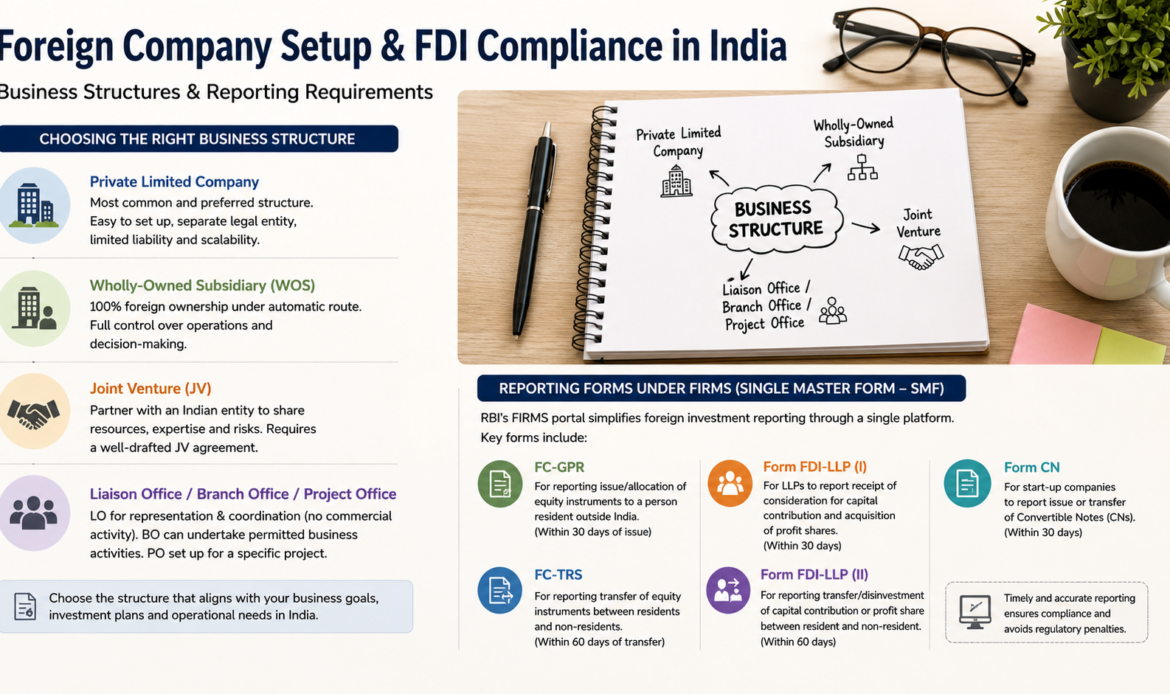
Choosing the right business structure is a critical aspect of establishing any entity in India. The decision regarding the business structure will have significant implications on a business’s operations, ownership, liability, and tax obligations. Below mentioned are some of the appropriate business structures for the purpose of foreign investment:
Incorporation of a company under the Companies Act, 2013 (“Companies Act”): In India, businesses are primarily established either as companies under the Companies Act or as Limited Liability Partnerships (LLPs). The choice between the two depends on factors such as capital investment, nature of the business, and available resources. Whilst LLPs are easier to establish and comply with, companies offer advantages in terms of funding and share allocation to investors.
For a quick business setup, registering as a Private Limited Company (PLC) is the most efficient option. Foreign companies can invest through FDI in most sectors, except prohibited ones. PLCs require a minimum of two individuals and Public Limited Companies must have at least seven individuals.
Other permissible routes are as follows:
- Wholly-owned subsidiary (WOS):In this structure, a foreign company can establish WOS in India by making 100% FDI through the automatic route. Opting for a WOS provides maximum control over operations and decision-making, making it an ideal choice for businesses seeking autonomy. Additionally, this structure offers limited liability protection as the liability of the parent company remains distinct from that of the subsidiary.
- Joint Venture: Foreign Companies can enter the Indian market by establishing a business partnership through joint venture (JV) with entities in India. JV allows for resource sharing, expertise exchange, and risk distribution, making them advantageous for businesses seeking local market knowledge and distribution networks. When considering a JV, it is crucial to carefully choose a reliable and compatible Indian partner. Clearly defining the structure, ownership, and decision-making arrangements in a well-drafted joint venture agreement is essential for a successful partnership.
- Liaison office: A liaison office or representative office can serve as a communication and coordination hub for a foreign company in India. While a liaison office facilitates activities such as market research, promotion, and networking, it is prohibited from engaging in commercial operations. This structure is suitable for businesses aiming to establish a presence in India without generating profits.[3]
- Branch office: Foreign companies have the opportunity to establish Branch Offices (BO) in India. These BOs can engage in various activities, such as importing/exporting goods, providing professional or consultancy services, conducting research aligned with the parent company’s work, facilitating collaborations between Indian and overseas companies, representing the parent company in India, acting as agents for buying and selling goods in India, offering IT services and software development, and providing technical support for products supplied by the parent or group companies. BOs can also represent foreign airline and shipping companies.
- Project office: Project Offices (PO) can be established in India for the sole purpose of executing specific projects. These offices are restricted from engaging in any other activities apart from those directly related and incidental to the execution of the project.
Entry Routes for Investment
FDI can be made through the Automatic Route (“Automatic Route”) or the Government Route (“Government Route”). Under the Automatic Route, no prior approval is required from RBI or the Government of India, and only information relating to the inflow needs to be provided to the RBI within 30 days.[4] FDI proposals not covered under the Automatic Route require governmental approval and are considered by the competent authority or administrative ministry/department. DPIIT also handles FDI proposals by Non-Resident Indians (NRIs) and Export-Oriented Units (EOUs)[6] requiring government approval.
In response to the Covid-19 pandemic and to prevent opportunistic takeovers/acquisitions of Indian companies, the Government of India made amendments to the Policy under Press Note 3 regulating investments from countries sharing land borders with India. The amendment has been incorporated into the Policy and the FEMA NDI Rules.[7]
Foreign Portfolio Investors (FPIs)[8] can make investments in accordance with the terms and conditions specified in Schedule II of the FEMA NDI Rules.[9] Registered FPIs and NRIs can invest or trade through registered brokers in Indian companies’ capital on recognised Indian stock exchanges, following the applicable schedule under the FEMA NDI Rules.[10]
Foreign Venture Capital Investors (FVCIs)[11] can make investments in accordance with the terms and conditions specified in Schedule VII of the FEMA NDI Rules.
Prohibited Sectors
As per the provisions outlined in the Policy, foreign investors can invest in various sectors within India. However, it is important to note that there are specific sectors listed under the Policy as “Prohibited Sectors”, where investment by non-residents is not allowed. It includes:
- Lottery Business;
- Gambling and Betting;
- Chit Funds;
- Nidhi Company(ies);
- Agricultural (excluding Floriculture, Horticulture, Development of seeds, Animal Husbandry, Pisiculture and Cultivation of vegetables, mushrooms etc. under controlled conditions and services related to agro and allied sectors) and plantation (other than tea plantation);
- Retail Trading;
- Trading in Transferable Development Rights;
- Real Estate Business or Construction of Farmhouses (except certain specified developments);
- Manufacturing of Cigars, Cheroots, Cigarillos, Cigarettes, Tobacco or Tobacco Substitutes; and
- Activities/Sectors not open to private sector investment including; atomic energy or railway operations.
Additionally, foreign investment is also prohibited in technology collaborations related to lottery businesses, gambling, and betting activities. This includes franchises, trademarks, brand names, and management contracts in these sectors.
Reporting forms
In 2018, the RBI implemented an internet-based reporting platform called Foreign Investment Reporting and Management System (FIRMS).[13] This system was introduced to streamline the reporting process for foreign investment in India by consolidating multiple forms into a single form known as the Single Master Form (SMF).[14] With FIRMS, applicants have access to online reporting facilities available. Some of the important forms under the SMF are as follows-
- FC-GPR (Foreign Currency – Gross Provisional Return): Used by an Indian company for the purpose of notifying the allocation of equity instruments to a person resident outside India. The form must be submitted within 30 days from the issuance date.[15]
- FC-TRS (Foreign Currency – Transfer of Shares): Used for reporting the transfer of equity instruments between residents and non-residents or vice versa. The form should be submitted within 60 days of the transfer or receipt/remittance of funds, whichever is earlier.[16]
- Form FDI-LLP (I): Required by LLPs to report the receipt of consideration for capital contribution and acquisition of profit shares. The form must be submitted within 30 days from the date of receipt of the amount of consideration.[17]
- Form FDI-LLP (II): Used for reporting the disinvestment or transfer of capital contribution of an LLP or profit share between a resident and a non-resident (or vice versa). The form should be submitted within 60 days from the date of receipt of funds.[18]
- Form CN: Used by start-up companies to report the issuance of Convertible Notes (CN(s)) to a resident outside India or the transfer of CNs between a resident in India and a resident outside India. The form must be submitted within 30 days of issue or transfer.[19]
Conclusion
India offers immense opportunities for foreign investors willing to navigate its entry and FDI regulations effectively. The DPIIT formulates FDI policies, while initiatives like Make in India promote investment. The Policy provides guidance, aligning with regulatory changes to attract and facilitate investments. Foreign investments are subject to the Automatic Route or the Government Route, with the latter requiring prior approval. Amendments have been made to regulate investments from countries sharing land borders with India, safeguarding Indian companies. Furthermore, choosing the right business structure is crucial for establishing a presence in India. Each structure offers unique advantages based on the business’s goals and requirements.
Reporting foreign investments is streamlined through the FIRMS portal. The SMF simplifies the reporting process, covering different reporting requirements. Different forms, such as FC-GPR, FC-TRS, Form FDI-LLP (I), Form FDI-LLP (II), and Form CN, cater to specific reporting requirements.
In conclusion, establishing a business entity in India presents remarkable opportunities, but it requires a well-informed approach and adherence to the regulatory framework. By grasping India’s FDI policies, choosing the appropriate business structure, and fulfilling reporting obligations, foreign companies can confidently navigate this dynamic market and contribute to the nation’s economic growth and development while achieving their global expansion goals.
[1] Department for Promotion of Industry and Internal Trade, Notification: F. No. P-36017/256/2020- Investment Promotion, Ministry of Commerce and Industry <https://dpiit.gov.in/sites/default/files/gazette_Notification_SIP_03December2021_0.pdf > dated 29th November, 2021.
[2] Department for Promotion of Industry and Internal Trade, Consolidated FDI Policy, Ministry of Commerce and Industry <https://dpiit.gov.in/sites/default/files/FDI-PolicyCircular-2020-29October2020.pdf> last accessed on 14th July, 2023.
[3] National Investment Promotion and Facilitation Agency, Doing Business in India, Government of India<https://www.startupindia.gov.in/content/dam/invest-india/Templates/public/Doing%20Business%20in%20India.pdf> accessed on 15th July, 2023.
[4] Reserve Bank of India, Master Circular on Foreign Investment in India, Part I, Section I: Foreign Direct Investments< https://www.rbi.org.in/scripts/BS_ViewMasterCirculars.aspx?Id=3630 > dated 2nd July, 2007.
[5] Id at 2, Section 4.3, Page 27.
[6] Id at 2, Section 4.1, Page 25.
[7] Id at 2, Section 3.1, Page 14.
[8] Id at 2, Defined under Section 2.1.21, Page 9.
[9] Id at 2, Section 3.1.5, Page 14.
[10] Id at 2, Annexure 8.
[11] Id at 2, Defined under Section 2.1.22, Page 10.
[12] Id at 2, Section 5.1, Page 28.
[13] Reserve Bank of India, User Manual For Single Master Form FIRMS, Page 3 <https://rbidocs.rbi.org.in/rdocs/FEMAMASTER/PDFs/SMF-FIRMS347E34AF5938415DAD0904E0584FB5A1.PDF> last accessed on 15th July, 2023.
[14] Reserve Bank of India, First Bi-monthly Monetary Policy Statement, 2018-19 Resolution of the Monetary Policy Committee (MPC) Reserve Bank of India <https://www.rbi.org.in/Scripts/BS_PressReleaseDisplay.aspx?prid=43573> dated 5th April, 2018.
[15] Rule 13.1(2), Foreign Exchange Management (Transfer or Issue of Security by a Person Resident Outside India) Regulations, 2017.
[16] Rule 13.1(4), Foreign Exchange Management (Transfer or Issue of Security by a Person Resident Outside India) Regulations, 2017.
[17] Filing procedure mentioned at Id 13, Page 47-55.
[18] Filing procedure mentioned at Id 13, Page 56-65.
[19] Filing procedure mentioned at Id 13, Page 66-74.

This article is for general information only and is not legal advice. Laws and notifications change; please take advice on your specific facts.
Related articles

FEMA and RBI Compliance for Foreign-Owned GCCs in India
25 Mar 2026

Cost of Setting up a Global Capability Centre in India – Legal and Compliance Framework
26 Feb 2026

What is the Best Structure for a Foreign Company to Start a GCC in India?
25 Feb 2026