
 Corrida Legal

Prevention of Sexual Harassment (POSH) Law Requirements in India
POSH Law Requirements in India: Key compliance rules, Internal Committee setup, complaint process, and employer duties explained.
Introduction
The ubiquitous problem of sexual harassment exerts its impact across diverse domains, especially in the workplace. Despite the escalating severity of the issue, women at workplace frequently refrain from reporting such incidents due to apprehensions regarding the potential risk of losing their livelihood, the fear of enduring social stigma, the negative impact on their professional standing and personal reputation as well as the daunting retaliation by the harasser.
In the landmark judgment of Vishaka vs. State of Rajasthan (“Judgement”), the Supreme Court of India formally recognised this menace. Further, it issued legally binding guidelines rooted in the principles of equality and dignity enshrined in the Constitution of India and the UN Convention on the Elimination of all Forms of Discrimination against Women (CEDAW) and directed the government to take cognizance.
With the objective of addressing this issue and providing a secure working milieu that upholds the welfare of women, the Sexual Harassment of Women at Workplace (Prevention, Prohibition and Redressal) Act, 2013 (“POSH Act”) and the Sexual Harassment of Women at Workplace (Prevention, Prohibition and Redressal) Rules, 2013 (“POSH Rules”) were passed by both houses of the Parliament in 2013.
This article endeavours to delve into the essential prerequisites of the POSH law while elucidating the importance of its enforcement.

Read another article: Moonlighting: Legal Repercussions Of An Open Secret And The Way Forward
Understanding The POSH Act And POSH Rules
The POSH Act applies to all workplaces in India, including government organisations, private sector, hospitality or nursing homes, sports institutes/facilities, or a dwelling place or house safeguarding the rights of women who are employed or visit any workplace, irrespective of their employment status.
Before diving into the intricacies of the POSH Act, let us first gain a comprehensive understanding of the concept of sexual harassment.
Meaning of Sexual Harassment: Sexual harassment (“Sexual Harassment”) includes any one or more of the following unwelcome acts or behaviour (whether directly or by implication), namely:
- physical contact or advances;
- a demand or request for sexual favours;
- making sexually coloured remarks;
- showing pornography; or
- any other unwelcome physical, verbal or non-verbal conduct of a sexual nature.
In the landmark judgment of Shanta Kumar vs. Council of Scientific and Industrial Research (CSIR) & Ors., Delhi High Court held that held that the presence of mere physical contact, even if unwelcome, does not automatically constitute Sexual Harassment. This definition of the term “Sexual Harassment” serves as a potential discouragement against lodging baseless complaints with the sole intention of harassing or intimidating the accused, particularly in cases where no genuinely sexually oriented conduct has occurred.
Key Compliances
To gain a comprehensive understanding of the essential provisions outlined in the POSH Act, it is imperative to delve into the fundamental facets of the 5W’s of the POSH Act.
What do you mean by Internal Committee and Local Committee?
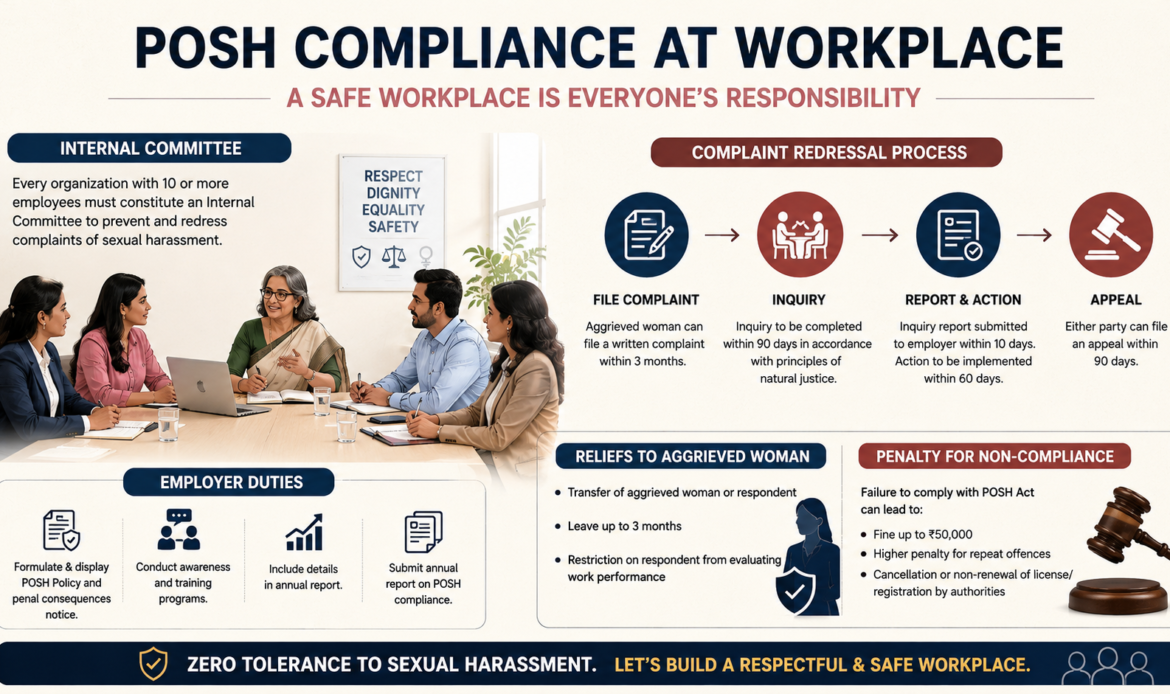
As per the provisions of the POSH Act, every workplace employing 10 (Ten) or more employees is required to constitute an Internal Committee (“Internal Committee”) to handle complaints related to Sexual Harassment and facilitate inquiry into the complaint. In situations where a workplace has multiple administrative units across various locations, it is necessary to establish an Internal Committee in each administrative unit. However, if a workplace has less than 10 (Ten) employees, all complaints of Sexual Harassment will be handled by the local committee established by district officers under the POSH Act.
What is the composition of the Internal Committee?
The Internal Committee shall comprise of a woman presiding officer, minimum 2 (Two) employee members and 1 (One) external member who may be affiliated with an Non-Governmental Organisation (NGO).Further, a minimum of half of the total members nominated for the Internal Committee must be women.
The presiding officer and each member of the Internal Committee shall hold their positions for a specified period, not exceeding 3 (Three) years, from the date of their selection, as determined by the employer.
What is the Complaint mechanism and procedure for conducting the Complaint?
Complaint mechanism: Any aggrieved woman who has been subjected to Sexual Harassment in the workplace has the right to submit a written complaint (“Complaint”) to the Internal Committee if constituted or the local committee, in the absence of an Internal Committee. This Complaint should be submitted within 3 (Three) months from the date of the incident or within 3 (Three) months from the date of the last incident in case of a series of incidents.
In situations, where the aggrieved woman is unable to submit the Complaint in writing, it is the responsibility of the presiding officer, any member of the Internal Committee, the chairperson of the local committee, or any member of the local committee to offer reasonable assistance to facilitate the process. In exceptional circumstances where the aggrieved woman could not adhere to the specified time frame for submitting the Complaint due to compelling reasons, the Internal Committee or the local committee may extend the filing deadline by a maximum of 3 (Three) months. Such an extension must be duly justified in writing, outlining the reasons for the delay.
In the event, the aggrieved woman is unable to file the Complaint due to her physical or mental incapacity, death, or any other legitimate grounds, her legal heir or any person as prescribed by the POSH Rules may act on her behalf and submit a Complaint.
Conciliation: Prior to commencing an inquiry, the Internal Committee or the local committee possesses the authority to engage in conciliation at the request of the aggrieved woman in order to resolve the matter with the respondent. If a settlement is achieved between the parties, the Internal Committee or local committee will document the terms of the settlement and forward it to the employer or district officer for appropriate action, as recommended. Furthermore, copies of the documented settlement will be provided to both the aggrieved woman and the respondent. It is important to note that conciliation cannot be based on financial settlement. In instances where a settlement is reached, the Internal Committee or local committee, as applicable, will refrain from conducting inquiry.
Procedure for conducting the inquiry:
- Upon submission of the Complaint, the aggrieved woman is required to submit 6 (Six) copies of the Complaint, accompanied by supporting documents and provide the names and addresses of the witnesses to the Internal Committee or the local committee.
- Once the Complaint is received, the respondent must be provided with one copy of the Complaint, obtained from the aggrieved woman within a period of 7 (Seven) working days. Additionally, the respondent is obliged to submit a response to the Complaint within a maximum of 10 (Ten) working days from the date of receiving the documents. The response should encompass a comprehensive list of documents and include the names and addresses of witnesses.
- If, without justifiable cause, the respondent fails to attend 3 (Three) consecutive hearings convened by the presiding officer or the chairperson, the Internal Committee or local committee possesses the authority to terminate the inquiry proceedings or render an ex parte decision on the Complaint. However, a written notice must be provided to the concerned party at least 15 (Fifteen) days in advance of such termination or issuance of an ex parte order.
- The Internal Committee shall conduct an inquiry into the Complaint while adhering to the fundamental principles of natural justice.
Inquiry report: According to the POSH Act, the investigation must be completed within a total of 90 (Ninety) days from the date of receiving the Complaint. Within 10 (Ten) days after the conclusion of the inquiry, the Internal Committee is obligated to furnish the employer with a comprehensive report of the investigation.
Lastly, it is crucial for the employer to implement the recommendations put forth by the Internal Committee within 60 (Sixty) days of receiving the inquiry report.
Punishment for Sexual Harassment: Unless specific service rules are in place, if the Internal Committee or the local committee determines that the allegation against the respondent has been proved, it shall advise the employer or the district officer, as appropriate, to undertake appropriate measures. These may include issuing a written apology, a warning, a reprimand or censure, withholding promotions, withholding salary increments, terminating the respondent’s employment or providing counselling sessions.
Appeal: In the event that a party disagrees with the recommendations or believes that they have been further wronged by their implementation or lack thereof, they have the option to lodge an appeal with the appellate authority notified under clause (a) of Section 2 of the Industrial Employment (Standing Orders) Act, 1946 (20 of 1946). This appeal must be submitted within a period of 90 (Ninety) days of the recommendations.
What are the other reliefs to the aggrieved woman during the pendency of the inquiry and non-compliance under the POSH Act?
Other reliefs: The Internal Committee is empowered to advise the employer to impose restrictions on the respondent from reporting on the aggrieved woman’s work performance or preparing her confidential report, and assign this responsibility to another officer; suggest the transfer of either the aggrieved woman or the respondent to an alternate workplace; or propose granting a leave of up to three months to the aggrieved woman.
False complaints: In cases where the Internal Committee, following a thorough investigation conducted in accordance with the prescribed procedure, concludes that a Complaint was deliberately false and made with malicious intent by the aggrieved woman, the Internal Committee shall, in consultation with the employer, undertake suitable measures against the aggrieved woman as deemed necessary.
Penalty for non-compliance under POSH Act: In the event of the employer’s failure to establish the Internal Committee or engaging in, attempting to engage in, or aiding the violation of any other provision outlined in the POSH Act or the POSH Rules, the employer may incur a fine of up to INR 50,000 (Indian Rupees Fifty-Thousand only). Moreover, if an employer, previously convicted of a violation under the POSH Act, commits a similar offense and is subsequently found guilty, the employer will face a penalty twice as severe. Additionally, depending on the circumstances, the government or local authority may exercise their prerogative to revoke or deny the renewal of the employer’s license or registration, which is indispensable for conducting their business operations.
What are the duties of the employers and the Internal Committee?
- Policy on Sexual Harassment and penal consequences notice of Sexual Harassment: Employers are obligated to formulate and implement an internal policy on sexual harassment, ensuring its communication to all employees. Furthermore, it is incumbent upon the employer to prominently display a penal consequences notice detailing the consequences of Sexual Harassment at a conspicuous place within the workplace.
- Awareness and Training Programs: Employers are required to conduct regular awareness programs and training sessions to educate employees about Sexual Harassment, its consequences and the Complaint filing procedure.
- Reporting Obligations: Employers must include information in their annual report which includes the number of cases filed and their disposal.
- Annual Report: The Internal Committee or the local committee (as the case may be) is responsible for preparing and submitting an annual report to the employer, which includes comprehensive information regarding the handling of Sexual Harassment cases within the workplace.
Conclusion
In conclusion, the implementation of the POSH Act is instrumental in cultivating a secure and inclusive work environment, with a particular emphasis on the well-being of women. By mandating the establishment of Internal Committees and the formulation of policies, the law ensures that organisations take proactive measures to prevent Sexual Harassment. Moreover, it serves as a strong deterrent, sending a clear message that such behaviour will not be endured.

This article is for general information only and is not legal advice. Laws and notifications change; please take advice on your specific facts.
Related articles
How to file annual POSH report in Maharashtra
17 Mar 2026
POSH vs disciplinary complaints: key difference, confidentiality and handling procedure
28 Feb 2026
POSH report filing in Delhi
19 Feb 2026